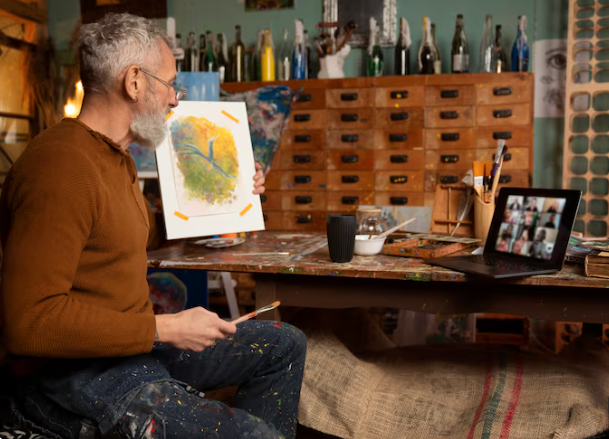
The boundary between digital and traditional art has become increasingly fluid. An artist might sketch a portrait on a tablet, paint it on canvas, and then use a digital image of the finished work to plan a print edition. Each stage contributes something different, yet all belong to the same creative process.
Digital art has expanded the choices available to painters, illustrators, sculptors, and printmakers. Its influence extends beyond the introduction of new tools. It also affects how artists develop ideas, approach materials, revise compositions, and understand the relationship between an original artwork and its reproductions.
A New Space for Planning and Experimentation
Traditional artistic techniques often require decisions that are difficult to reverse. A dark wash can permanently alter a watercolor painting, while carving a block removes material that cannot easily be restored. These limitations encourage care, but they can also make experimentation costly.
Digital tools offer a separate space for testing possibilities. Artists can explore compositions, compare color arrangements, and adjust proportions before committing to physical materials. A painter, for example, might photograph an unfinished canvas and digitally test several background colors.
This approach does not eliminate the uncertainty of working with paint. A color on a screen will behave differently from pigment on a textured surface. However, digital studies can help artists identify promising directions and approach the physical work with a clearer intention.
Changing Approaches to Drawing
Digital drawing retains many principles associated with traditional draftsmanship. Observation, proportion, gesture, perspective, and line quality remain essential, regardless of whether the artist uses charcoal or a stylus.
What changes is the range of available actions. Layers allow artists to separate construction lines from finished marks. Transform tools make it possible to reposition an element without redrawing an entire scene. An adjustable canvas can support detailed work alongside a broader view of the composition.
These habits can influence drawing on paper. Artists may become more deliberate about developing a piece in stages or testing alternative arrangements through thumbnail sketches. At the same time, physical drawing offers resistance and permanence that encourage a different kind of attention. Moving between the two can make artists more aware of their decisions.
Digital Influences on Painting
Digital painting has introduced visual effects that artists sometimes reinterpret through physical media. Luminous color, sharp transitions, layered transparency, and deliberately fragmented imagery can all become starting points for experiments with paint.
An artist inspired by digital layering might combine thin glazes with opaque passages. Another might translate the appearance of a screen glitch into interrupted brushstrokes or displaced sections of an image.
The translation is rarely exact. Paint has weight, texture, and a relationship with light that a screen image does not share. These differences can become the most interesting part of the artwork. Rather than simply copying a digital effect, the artist discovers what happens when that effect encounters a physical surface.
Expanding Printmaking and Mixed Media
Printmaking provides a natural meeting point for digital and traditional processes. Artists can develop images digitally and incorporate them into works that also use carving, drawing, painting, or hand printing.
A digitally printed image might form the foundation of a collage. Handwritten marks, fabric, ink, and painted textures can then alter the print, giving each version its own character. Conversely, a physical drawing can be scanned, rearranged, and returned to paper in a different form.
Such combinations encourage artists to think carefully about sequence. Printing first and painting afterward produces a different result from scanning a finished painting and manipulating its image. The order of operations becomes part of the artistic technique.
Supporting Sculptural Exploration
Digital modeling also influences how some artists prepare three-dimensional work. A virtual model allows a sculptor to examine proportions, rotate a form, and explore variations before building a physical piece.
This can be useful when planning complex structures or comparing several possible designs. Yet a digital model cannot fully communicate how clay yields under pressure, how wood responds to carving, or how a finished sculpture feels in a shared space.
Working physically remains a process of discovery. Digital preparation can guide that process, while the material itself may suggest changes the artist could not anticipate on a screen.
Reconsidering Skill and Originality
The combination of digital and traditional methods raises questions about artistic skill. Easy access to editing tools can make certain changes faster, but speed does not automatically produce a convincing artwork. Choosing what to change—and understanding why—still requires judgment.
Originality also depends on more than the medium. An artist’s observations, choices, interpretation, and treatment of materials help shape a distinctive voice. A digital brush and a physical brush both require purposeful use.
Understanding the strengths and limitations of each medium allows artists to make more meaningful choices. Sometimes a digital revision serves the work. In other cases, an irregular line or an unexpected stain deserves to remain.
A Broader Artistic Vocabulary
Digital art’s influence on traditional techniques is best understood as an expansion of artistic possibilities. It provides new ways to prepare, experiment, combine images, and reconsider familiar methods.
Traditional materials continue to offer qualities that digital environments cannot fully reproduce: tactile surfaces, physical scale, unpredictable interactions, and the visible history of a handmade object. By moving between these experiences, artists can develop a broader vocabulary while retaining a close connection to their materials and ideas.
Read more: How Creative Expression Helps Preserve Cultural Identity in Modern Society