
Key Takeaways
- Soil type, groundwater, nearby loads, and weather all affect excavation stability.
- New Jersey projects can encounter coastal sand, urban fill, clay-bearing soils, and variable groundwater conditions.
- Protective systems must fit the site, excavation depth, work sequence, and adjacent-property risks.
- Conditions can change quickly, so inspections must continue throughout the work.
- Careful planning protects workers, utilities, roads, neighboring structures, and project schedules.
Table of Contents
- Why Soil Matters Before Digging Begins
- Common Soil Types and Their Behavior
- How Water and Weather Change Ground Conditions
- Nearby Buildings, Utilities, and Equipment
- Choosing the Right Protective System
- A Practical Excavation Planning Process
- Inspections, Monitoring, and Site Adjustments
- Common Planning Mistakes to Avoid
- Common Questions About Excavation Safety
- Final Thoughts
Deep excavation planning in New Jersey begins with a basic reality: the ground is part of the project. From sandy coastal sites and high water tables near the Shore to constrained redevelopment parcels in North Jersey, soil conditions influence how an excavation can be opened, supported, monitored, and safely used. Experienced earth shoring contractors account for the soil profile as well as the buildings, streets, utilities, and property lines around it.
A sound plan does not treat excavation support as a standard item selected only by depth. It evaluates the actual materials on site, the presence of water, changing weather, surcharge loads, and the sequence of construction. That site-specific approach is especially important when a deep cut is close to an occupied building, an active roadway, a rail corridor, or a buried utility network.
Why Soil Matters Before Digging Begins
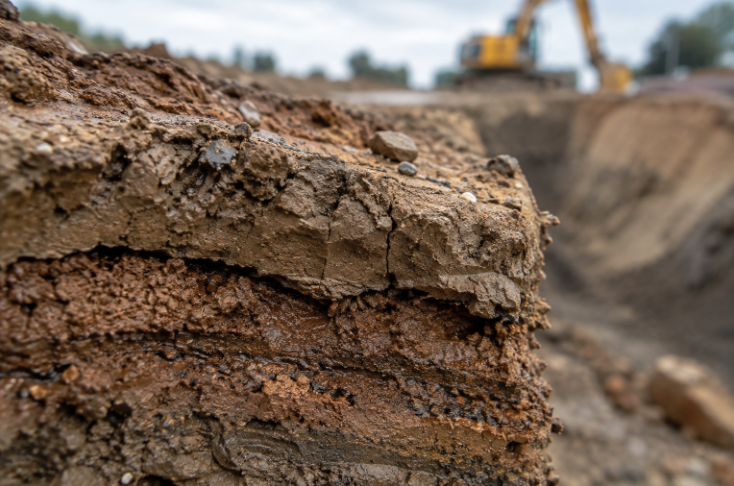
Soil provides resistance around an excavation, but that resistance is not uniform. A site can contain layers of sand, silt, clay, gravel, fill, organic material, or construction debris at different elevations. Past grading, demolition, utility installation, and previous foundation work can also leave disturbed ground that behaves differently from undisturbed native soil.
Early review of borings, geotechnical information, surveys, and available site records helps the team identify conditions that may affect wall movement or water control. Field observations remain essential because documents describe prior findings, while excavation reveals the conditions actually encountered. A weak seam, seepage zone, or unexpected fill layer can require a revised approach before workers proceed below grade.
Common Soil Types and Their Behavior
Granular Soil
Sand, gravel, and loose fill are granular materials. They may shift readily when unsupported, particularly when vibration, seepage, or changes in moisture reduce interlocking between particles. Sandy conditions are a practical concern on many coastal and waterfront-adjacent New Jersey projects, where groundwater management can be closely tied to excavation stability.
Cohesive Soil
Clay and silty clay can appear firm at first, but they can crack, soften, or lose support when exposed to water and changing weather. A vertical face that looks stable at the start of a shift should not be assumed safe later without inspection. Moisture changes and stress from nearby activity can alter its performance.
Mixed or Previously Disturbed Soil
Urban redevelopment sites may include fill, buried masonry, old foundations, utility trenches, and inconsistent layers. Mixed ground is less predictable because materials can vary over short distances. That uncertainty calls for conservative sequencing, close observation, and a support plan that can adapt to verified conditions.
How Water and Weather Change Ground Conditions
Water is one of the most important variables in excavation work. Rain can saturate surface soils, add weight, and promote sloughing at the edge. Groundwater seepage can carry fine material, soften soil, or create standing water in the excavation. Freeze-thaw cycles may also open cracks and contribute to movement near exposed walls.
Project teams should reassess conditions after storms, utility leaks, changes in nearby pumping, or equipment activity near the excavation. The planning guidance for trenching and excavation work emphasizes evaluating soil, identifying utilities, controlling heavy-equipment routes, and using protective systems before workers enter an excavation.
Nearby Buildings, Utilities, and Equipment
Excavation affects more than the soil within the property line. Removing ground near a foundation, sidewalk, roadway, retaining wall, or utility can change the support available to those features. Trucks, cranes, stored materials, and spoil piles can also add surcharge loads near the edge, increasing stress on the excavation wall.
Consider a tight infill site in Jersey City, Newark, or a commercial district on the Shore. The available work area may be bounded by an older neighboring building on one side, a sidewalk on another, and active utilities below the street. Small changes in loading, water flow, or wall movement can matter greatly in that setting, making utility locating, access planning, and monitoring central parts of the work.
Choosing the Right Protective System
Protective systems should be selected by qualified professionals based on soil conditions, excavation depth, water, adjacent structures, property limits, and construction methods. Common approaches include:
- Sloping: Cutting walls back at an appropriate angle to reduce the risk of collapse where space and soil conditions allow.
- Benching: Creating stepped levels in suitable soils when the design and field conditions support that method.
- Shoring: Installing structural systems that resist soil movement and protect the excavation face.
- Shielding: Using trench boxes or similar systems to protect workers inside an excavation.
- Water control: Managing seepage and standing water to prevent them from undermining the planned protective approach.
OSHA explains that soil analysis guides the choice of sloping, benching, shoring, or shielding, while safe entry, spoil placement, water hazards, and inspections also require attention. A protective system is not a substitute for planning the entire work zone.
A Practical Excavation Planning Process
- Review available information. Gather surveys, geotechnical data, utility records, prior plans, and information about nearby structures.
- Verify field conditions. Compare documents with the soil, water, and site constraints encountered before and during excavation.
- Map surrounding risks. Identify buildings, roadways, slopes, utilities, water sources, traffic, and equipment routes.
- Select a protective approach. Match the system to actual conditions and the anticipated construction sequence.
- Assign inspection responsibility. Establish who can identify hazards, stop work, and require corrective action.
- Prepare for emergencies. Plan access, egress, communications, exclusion areas, and stop-work procedures.
Inspections, Monitoring, and Site Adjustments
Excavations require ongoing attention because conditions may change during the same shift. Warning signs can include surface cracking, bulging or sloughing walls, new seepage, standing water, settlement near an edge, or equipment positioned too close to the cut. A competent person should inspect the excavation before entry and after hazard-increasing events.
For larger or sensitive projects, settlement points, wall-movement observations, and vibration monitoring can help the team assess whether the excavation is proceeding as anticipated. If conditions no longer match the approved plan, work should pause while the responsible professionals determine the next safe step.
Common Planning Mistakes to Avoid
- Assuming every layer of soil will behave the same way.
- Relying on older reports without verifying current site conditions.
- Placing spoil piles, materials, or heavy equipment too close to an excavation edge.
- Ignoring rainwater, seepage, standing water, or utility damage.
- Failing to inspect after a significant change in weather, loading, or site activity.
- Selecting protection based on depth alone rather than the complete site environment.
- Allowing schedule pressure to override sound engineering and safety decisions.
Common Questions About Excavation Safety
Can soil conditions change after excavation begins?
Yes. Rain, drying, groundwater, vibration, nearby loading, and temperature changes can affect soil behavior after work starts.
Why is previously disturbed soil a concern?
Disturbed soil may contain loose layers, buried debris, old trenches, or inconsistent fill. These conditions can be less predictable than undisturbed ground.
Does every deep excavation need the same support system?
No. The appropriate system depends on soil and water conditions, depth, site geometry, adjacent structures, available space, and work sequence.
Final Thoughts
Safe deep excavation planning in New Jersey starts with understanding the ground and respecting how quickly site conditions can change. By evaluating soil, water, weather, nearby structures, utilities, and construction loads before work begins, teams can select more appropriate protection, respond to developing hazards, and reduce costly surprises below grade.
Read more : 350+ Funny Girl Names That Will Make Everyone Laugh
1 comment