
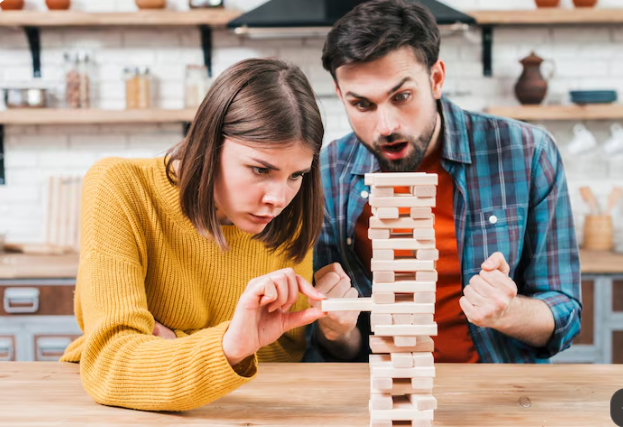
A puzzle presents a clear challenge: something is missing, an arrangement does not work, or a solution remains hidden. The player must examine the information, consider possible actions, and decide what to try next.
This process makes puzzle games an engaging setting for practicing different ways of thinking. Whether someone is assembling a jigsaw, solving a word puzzle, or navigating a digital maze, progress often requires observation, experimentation, and a willingness to reconsider an approach.
The skills practiced depend on the puzzle and how the player engages with it. Becoming better at one game does not automatically improve every aspect of everyday reasoning. Still, thoughtful play provides useful opportunities to explore how problems can be approached.
Breaking Large Challenges Into Smaller Parts
A difficult puzzle can seem overwhelming when viewed as a single task. Players often make progress by identifying smaller problems they can solve first.
In a jigsaw puzzle, this might mean separating edge pieces, grouping similar colors, or assembling a recognizable object. In a logic puzzle, it could involve resolving the clues with the fewest possible interpretations.
Each completed section reduces uncertainty and provides information for the next step. Players practice asking practical questions: What do I already know? What can I work out now? Which part depends on something else?
This approach gives structure to a challenge that initially appears confusing.
Practicing Observation and Pattern Recognition
Many puzzles ask players to notice relationships among shapes, numbers, words, or symbols. A repeating sequence may reveal a rule, while a small difference may distinguish the correct option from several convincing alternatives.
However, recognizing a pattern is only the beginning. Players also need to check whether it holds across the available information.
For example, a proposed number rule might explain the first few entries but fail later. Testing the idea helps distinguish a useful pattern from a coincidence.
This combination of noticing and checking encourages careful reasoning. It also shows why an appealing first impression may need further examination.
Learning Through Experimentation
Some puzzles cannot be solved through observation alone. Players must try an action and study what happens.
A digital physics puzzle might require moving an object, changing its angle, or adjusting the order of events. Each attempt provides feedback about the game’s rules.
Experimentation becomes more informative when it is deliberate. Changing one element at a time makes it easier to understand which action affected the result. Repeating unsuccessful moves without reflection offers less information.
Players can strengthen this habit by making a prediction before acting: “If I move this piece here, that route should open.” Comparing the prediction with the outcome gives the next attempt a clearer purpose.
Encouraging Flexible and Creative Thinking
Puzzle solving sometimes stalls because the player has made an assumption that the puzzle does not require.
A person might assume that every object must be used, that a route must remain inside an obvious boundary, or that a word has only one meaning. Questioning such assumptions can reveal another approach.
Creative thinking also appears in generating alternatives. Instead of searching immediately for one perfect answer, players can consider several possibilities and assess them against the rules.
Creativity remains connected to the problem’s constraints. An unusual idea becomes useful when it explains the clues or produces a workable solution.
Making Mistakes Useful
An unsuccessful attempt can reveal valuable information. It may eliminate an option, expose a contradiction, or show that the current strategy is incomplete.
This makes puzzles a setting in which players can practice revising decisions. Rather than treating an error as the end of the task, they can ask what it has clarified.
The level of challenge matters. A puzzle that is too easy offers little reason to reconsider an approach, while one that is far too difficult may lead to random guessing. Suitable hints can help players move forward while preserving the opportunity to reason for themselves.
Developing Planning and Awareness of Thinking
Some puzzles require players to anticipate several steps. Moving one piece may solve an immediate problem while blocking a later action.
Players therefore need to compare short-term progress with the overall goal. They may work backward from the desired result or keep certain options available until more information emerges.
Reflecting afterward adds another layer of learning. Questions such as “Why did that strategy work?” and “Which assumption slowed me down?” help players understand their own process.
Explaining a solution to someone else can make hidden gaps in that understanding easier to notice.
Making Puzzle Play More Thoughtful
A varied selection of puzzles creates opportunities to practice different approaches. Word puzzles, spatial challenges, deduction games, and open-ended construction tasks each place different demands on the player.
The most useful habit is to engage actively: explain a choice, test an idea, review a mistake, and consider another method. When connecting a puzzle strategy to schoolwork or an everyday task, discuss exactly how it applies rather than assuming the connection is automatic.
Puzzle games offer more than the satisfaction of reaching an answer. They create opportunities to observe carefully, explore alternatives, and make progress through uncertainty—one considered decision at a time.
Read more: Why Public Art Installations Are Transforming Modern Urban Spaces